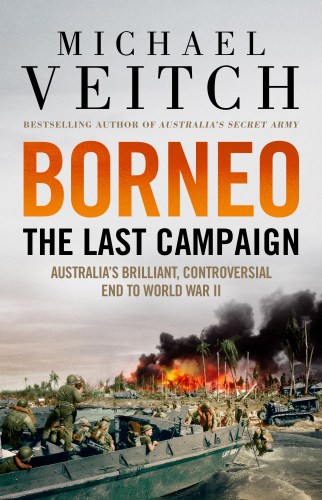
Borneo
The Last Campaign
By Michael Veitch
Published by Hachette
RRP $34.99 in paperback | ISBN 9780733648533
I am left wondering if Michael Veitch’s chance encounter with the then president of the Victorian branch of the RSL, Bruce Ruxton, was the catalyst for his enduring interest in the last campaign of World War II, Codenamed OBOE. The operation involved a triple-pronged invasion of the Japanese-occupied island of Borneo in mid-1945.
In that chance encounter thirty years ago, which Veitch describes in his introduction, Ruxton talked of his involvement in the operation as a private of 2/25th Infantry Battalion, coming ashore at Balikpapan.
It was one of the largest amphibious invasions of the entire war, and a virtually all-Australian operation.
Over the final twelve weeks of the war, the 1st Australian Army Corps chased down and fought the remnants of the Japanese army over burning oil fields, up tropical rivers, along leech-ridden jungle tracks and across endless hills, valleys and ridges.
Far from being the easy ‘mopping-up’ the men had been told to expect, Borneo turned out to be as savage as anything the Aussies had hitherto encountered in the Pacific, as the Japanese – despite the inevitability of their defeat – continued fighting with fanaticism, tenacity and shocking brutality.
The objectives were to secure Borneo’s oil facilities and liberate its long-suffering people.
OBOE involved more than 70,000 Australian military personnel, of which over 2000 became casualties, with nearly 600 killed. It was also where the two final Australian Victoria Crosses of the war were won, as well as literally dozens of other awards for bravery.
OBOE was superbly executed, achieved all of its objectives, and was the very last sustained Allied action of the war.
Published to coincide with the 80th anniversary of the operation, this is a highly readable account of what took place, including the horror the Australian men were to encounter in the aftermath of the Japanese retreat.
Veitch always regretted not following up with Ruxton to get his personal account of what he witnessed. Veitch, however, is right when he says the ultimate verdict on the operation was that it was a campaign that should never have happened.
The Japanese were already defeated. But such statements would have been of little comfort to the families of the men who died. For their sake, the operation needs to be remembered and their contribution honoured.
—
 militarybooksaustralia.com