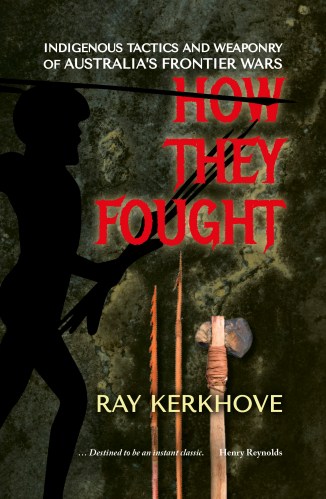
How They Fought
Indigenous Tactics and Weaponry of Australia’s Frontier Wars
By Ray Kerkhove
Published by Boolarong Press
RRP $39.99 in paperback | ISBN 9781922643582
Frontier wars is not a concept that is universally accepted among the general public in Australia.
Perhaps it’s because the settlement of Australia by Europeans lacks the defining war of independence such as occurred in America. Or the American Civil War in which armies we can recognise faced off against each other.
Nevertheless, what is an immutable fact in Australian history is that conflict occurred between the white settlers and the First Nations people as pastoralists pushed further and further out into First Nations lands.
But how did Australia’s indigenous population fight? What weapons did they use? What strategies? Did they form alliances with other groups? Did they train? And leadership? How was that decided?
Ray Kerkhove has spent years researching this topic, feeling there was a gap in our understanding of the Frontier Wars and how they were conducted.
In taking up this challenge, he has produced a fascinating book, full of detail of tactics, weaponry, decision-making and the like.
Here is Ray Kerkhove, in his own words, describing his motivation for writing the book:
‘Well I wrote this to fill a gap.
I want to show that Aboriginal people had a military system. I think this is vital for the recognition of Frontier Wars as proper wars.
No one has written about this before.
Everyone was writing about frontier wars but no one explained how Aboriginal people organised themselves to fight, how their weapons worked, what a typical skirmish between blacks and whites looked like; the objectives of Aboriginal people when they made an attack (what their plan was when they did this or that).
No one had even explained their modes of defence or strategies or internal ranking.
The book is the very first attempt I know of to work this all out. I read hundreds of accounts of individual battles or attacks, and also lots of early ethnographies, and gradually worked out the main tactics and the structures First Nations groups used when defending or attacking.
I did this by collating all I could find of what Aboriginal people themselves said they were doing or otherwise what we can work out from early first hand accounts.
I want the reader to realise Aboriginal warriors fought with great genius and efficiency often wounding and killing whites, escaping the police and turning back the tide of settlement for months to years. I want people to see it wasn’t just a lot of Aboriginal people being passively massacred but rather a real war in which whites had a lot to fear and were often at a disadvantage.
I want to show that Aboriginal people had a military system. I think this is vital for the recognition of Frontier Wars as proper wars.’
Unique is an over-used term but it certainly applies to this book. This book demands that readers jettison accepted ideas.
Take the issue of leadership as an example.
It was widely assumed that hunter-gatherer societies were less hierarchical than developed societies. Yet the fact that leaders emerged to lead resistance efforts renders this idea obsolete.
This book has won high praise from highly-respected historians whose names are very familiar in this space. Here are two examples:
‘This is an outstanding book: the fruit of years of prodigious research. It will profoundly influence the way we think about Australia’s Frontier Wars …’ Professor Henry Reynolds
‘How They Fought is at the forefront of a new military history of resistance warfare and will be an important resource for Australians to truly comprehend the most significant conflict of their history, the Australian Wars.’ Dr Stephen Gapps
In my opinion, there is now no room for ignorance on the issue of Australia’s Frontier Wars. The body of scholarly work on the topic that is now readily available must surely satisfy the doubters.
It is, indeed, a fascinating book, as well as an eye-opening book.
WATCH THE AUTHOR INTERVIEWED ON ABC BREAKFAST AT THIS LINK.
—
 militarybooksaustralia.com