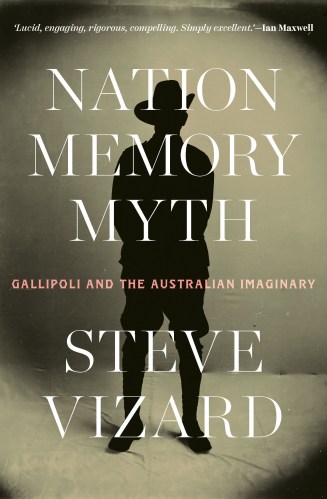
Nation, Memory, Myth
Gallipoli and the Australian Imaginary
By Steve Vizard
Published by Melbourne University Press
RRP $39.99 in paperback
ISBN 9780522881271
This book has arisen from what author Steve Vizard describes as ‘another scattergun dinner conversation with my wife and children – it must have been 25 April, Anzac Day – this time about the persistent, treasured and yet puzzling place of Gallipoli in Australian life.’
The question, no doubt, was how did the myth of Gallipoli become the sacred bearer of Australian national values and identity?
It was after all an ignominious defeat yet it left Australia with a ‘foundational myth’ and the Anzac spirit occupying a revered place in Australian culture.
This book, Vizard writes, is a work that focuses on Gallipoli as a ‘story’ not as an ‘event’.
But of course the uncritical reverence for the Gallipoli story provoked responses such as historian Joan Beaumont’s description of it being ‘misogynistic and anachronistic’ and who could argue with that.
In this scrupulously researched close reading of the Gallipoli mythology, Vizard dissects the elements common to all national myths that transform them into compelling symbolic, performances of cultural memory and kinship, unpicking the tensions and explaining the ambiguities embodied within.
Nation, Memory, Myth offers the reader a challenging new look at the extraordinary vitality of myth as a unifying force that generates meaning for a nation and its citizens. Only by understanding myth’s evolution across time and by disentangling it from history, memory and forgetting, can we begin to sense what an Australia in the twenty-first century may mean.
OBSERVATION: Could it be as simple as the desire of the ordinary men and women of Australia to preserve a public holiday that has led them to treat the Gallipoli myth, and therefore 25 April, with such reverence? I will leave the reader to decide.
 militarybooksaustralia.com