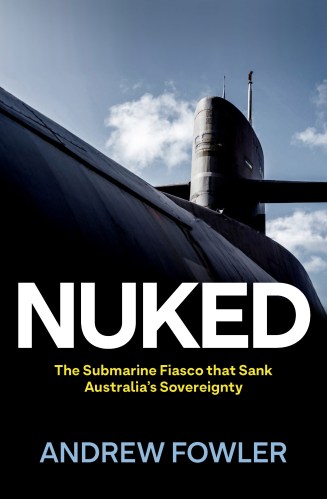
Nuked
The Submarine Fiasco that Sank Australia’s Sovereignty
By Andrew Fowler
Published by Melbourne University Press
RRP $35.00 in paperback
ISBN 9780522880311
Australia’s decision to acquire a new submarine fleet was always expected to be a torturous process. But who could have predicted the trail of wreckage it left behind? How deeply embarrassing was it for Australia to have the French President Emmanuel Macron call our then Prime Minister Scott Morrison a ‘liar’.
Deep inside the Australian Government a secret group was determined to overthrow the winning French bid for the submarine contract and tie the acquisition of Australia’s foremost military capability to the willingness of America to share its nuclear secrets… and its submarines.
The fingerprints of then Defence Minister Peter Dutton—and now prime ministerial aspirant—are all over the decision to dump the French contract. As this book reveals, he is stridently pro-America, and anti-China, which I personally find surprising in a world where China is Australia’s major trading partner and the source of our years-long prosperity. The Liberal National Party Coalition seems to speak with one voice on this.
And yet, is this what Australians really want? Is it in Australia’s best interests? Given the current White House resident, who might best be described as erratic and unpredictable, it would seem more than ever to be vitally important that Australia stands on its own two feet and determines its own defence policy, rather than ceding its sovereignty to America, as the sub-title of this book suggests.
Fowler has done an excellent job in digging below the surface to uncover the intrigue, the lies, the dissembling and the downright manipulation by a government whose ideology, once exposed, might be said to be out of step with the mainstream Australian population.
How concerned should Australians be that one of the architects of this fiasco is now aiming to occupy The Lodge? What is he likely concealing behind the bonhomie so much in evidence in the election round?
I have below extracted a few paragraphs from a piece in The Guardian by Daniel Hurst, Foreign Affairs and Defence Correspondent, with a link to the entire article. In an interview with Hurst, Andrew Fowler said he began researching the book after becoming fascinated with “the overuse of executive power of government in the Morrison government, particularly the exposure of his five secret ministries”.
“I thought that the arrival of a $368bn secret deal that was done and then sprung on the public and the opposition party at the last moment would require an investigation,” he said.
Fowler said he did not believe there had been adequate public debate in Australia about the merits of AUKUS, the security partnership with the US and the UK that involves the nuclear-powered submarine project but also collaboration on other advanced defence technologies.
“I think we debate the dollar-and-dime arguments, as the Americans might say, but we don’t debate the really big issues,” Fowler said.
“I don’t give advice to government but I think the Australian people have a right to know what the submarines are being bought for. They’re being bought to run with the Americans and Japan to contain the rise of China.”
Fowler said the then Labor opposition was put “in a diabolical position” when forced by Scott Morrison to make a quick decision on whether to support Aukus in 2021.
The last word goes to the author Andrew Fowler:
‘Just as Morrison was only too willing to trade Australia’s independence for the chance to win an election, so too was Labor. Now it is left to make work a deeply flawed scheme that, more than ever, ties Australia’s future to whoever is in the White House.’
VERDICT:
The revelations in this book are illuminating and troubling. At the heart of the AUKUS decision lies a deeply entrenched ideology determined to shape Australian thinking in ways that don’t necessarily serve the nation’s best interests, but rather the vested interests and deeply held convictions of a few, supported by a right wing press solidly behind the conservative cause.
As others have pointed out, Australia’s commitment to nuclear-powered submarines paves the way for Dutton’s pivot to nuclear power plants, the economic and environmental impacts of which are unknown.
I join with other reviewers in describing this book as a serious contribution to the ongoing debate about AUKUS. A debate the Australian public is entitled to have.
 militarybooksaustralia.com