1992-93: Australian Army Campaigns Series – 31
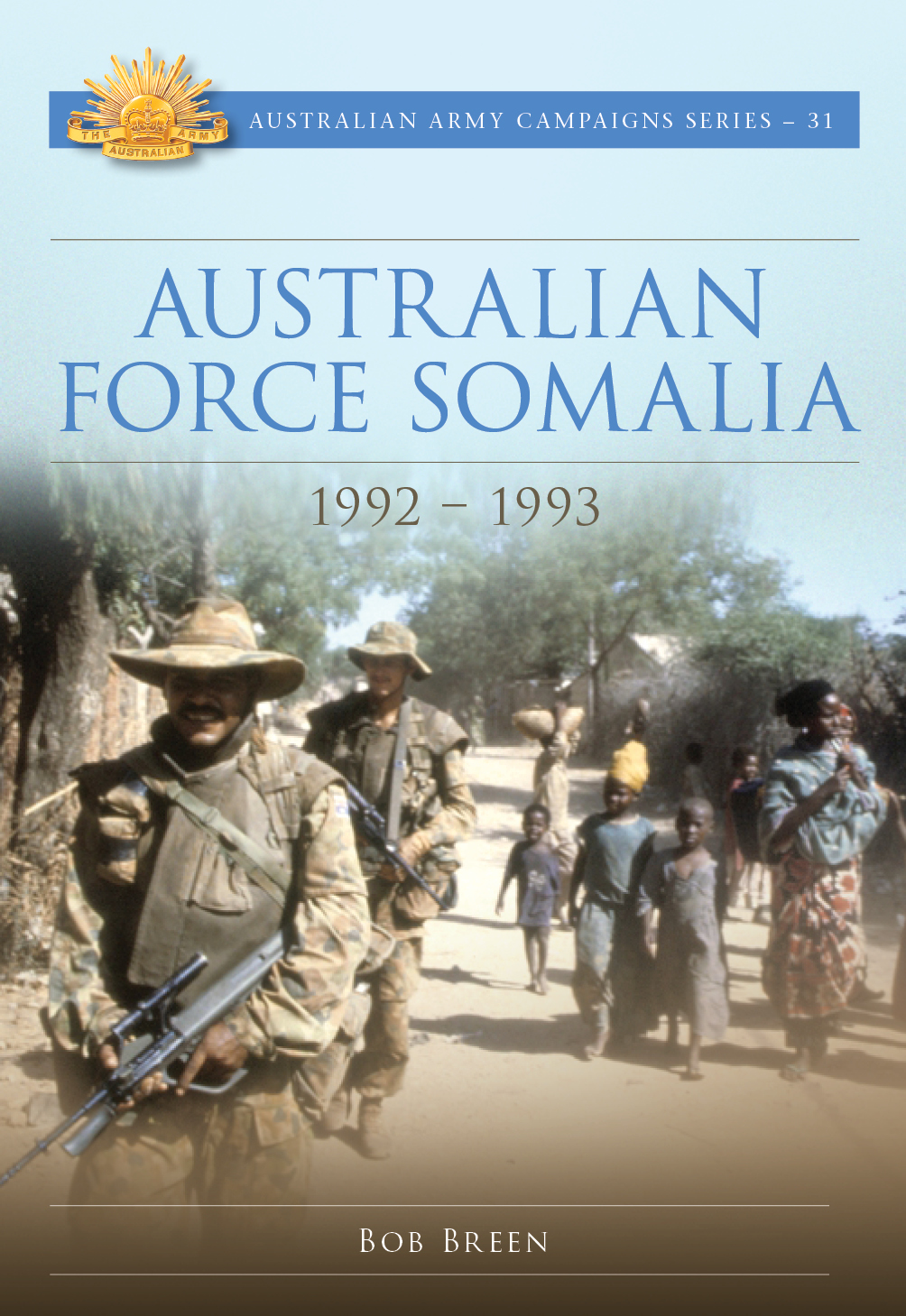
Australian Force Somalia
1992-93
Australian Army Campaigns Series – 31
By Bob Breen
Published by Big Sky Publishing
RRP $19.99 in paperback | ISBN 9781922615183
Author Bob Breen, writing in 2021, pulled no punches in his criticism of the ADF logistic organisations at the time of this intervention. He was well placed to assess the intervention. He had served as Colonel (Operations Analysis) for Land Commander – Australia from 1992 until 2002, conducting first hand research in Somalia in 1993.
He writes in the preface to this book:
“The ambivalent sustainment of the AFS [Australian Force Somalia) reflected poorly on ADF logistic organisations, which were unrehearsed and indifferent about the sustainment of land forces deployed overseas. While the Americans supplied the basics, such as rations, water, fuel and ammunition to the 1stBattalion, the Royal Australian Regiment Group (1RAR Group), the lack of US-equivalent spare parts of the Group’s fleet of vehicles and equipment constrained operations, increased risk and lowered morale. RAAF air supply arrangements were sporadic and exposed frustrating coordination difficulties between levels of command in Canberra, Sydney and Melbourne, and between the Services for supporting deployed land forces. …”
BACKGROUND
In 1992, civil war, drought and economic collapse left four million Somalis destitute, displaced and starving. Twenty-six nations participated in a ‘coalition of the willing’ with the Australian Force Somalia comprised of a 1,000-strong battalion group based on 1st Battalion, the Royal Australian Regiment from the 3rd Brigade in Townsville as well as a small national liaison headquarters from 1st Division in Brisbane.
Opposing the US-led Unified Task Force were Somali warlords and their militia armies that had been pillaging humanitarian aid and terrorising the Somali population during a bloody civil war. American airpower forced the warlords to send their armies into hiding across the border, but thousands of bandit groups, criminal gangs and violent political factions remained to threaten humanitarian operations and the safety hundreds of ex-patriate aid agency staff.
As Breen notes, Australian Army units will serve in troubled parts of the world in the future. It is however the lessons learned from the ‘unforgiving school of trial and error’ in Somalia in 1992/93 will be invaluable in the future. The lessons will apply not only to those confronting hostile groups on the frontline but also to those who command and support them from higher levels of command.
Operations in 1993 were Exhibit A for change in the ways and means for mobilising, preparing and sustaining land forces serving overseas.
VERDICT:
This is a well-written account of an Australian overseas deployment that many may have forgotten. There are any number of world trouble spots where Australia may in future be involved in humanitarian interventions. We would hope that thirty years on, the lessons of Australian Force Somalia have been well and truly learned.
 militarybooksaustralia.com